All species › Fish › Blue Catfish
Blue Catfish
Ictalurus furcatus
Fish · family Ictaluridae · order Siluriformes
- G1
Critically imperiled - G2
Imperiled - G3
Vulnerable - G4
Apparently secure - G5
Secure
NatureServe global rank G5: secure[2].

- Endangered Species Act
- Not listed[1]
- NatureServe global rank
- G5 Secure[2]
- Native in
- 19 states[3]
- Longest recorded life
- 21 years[4]
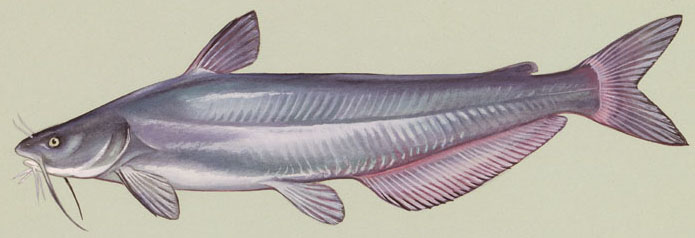
The Blue Catfish is a fish in the catfish family Ictaluridae[5]. It is not listed under the US Endangered Species Act, and NatureServe ranks it Secure worldwide[1][2].
Conservation status
NatureServe gives the Blue Catfish a global rank of G5, which means Secure[2]. Its national rank for the United States is N5, also Secure[6]. The IUCN Red List category recorded by NatureServe is Least concern[7]. The species is not listed as endangered or threatened under the US Endangered Species Act[1]. NatureServe says the trend over recent years is uncertain, but probably fairly stable or slowly declining[8].
Where Blue Catfish lives
NatureServe lists the Blue Catfish as native in 19 US states and territories, including Texas, Louisiana, Mississippi, Tennessee, Missouri and Ohio[3]. It has been introduced, which means people brought it in, in places such as Arizona, Colorado, Maryland, Oregon, Virginia and Washington[10]. NatureServe ranks it as extirpated or possibly extirpated, which means gone from the state, in Pennsylvania and West Virginia[11].
- Native
- Introduced
- Extirpated or possibly extirpated
Show state ranks (31 states)
| State | Rank | Meaning |
|---|---|---|
| Alabama | S5 | Secure |
| Arizona | SNA | Not Applicable |
| Arkansas | S4 | Apparently Secure |
| Colorado | SNA | Not Applicable |
| District of Columbia | SNA | Not Applicable |
| Georgia | S4 | Apparently Secure |
| Idaho | SNA | Not Applicable |
| Illinois | S2 | Imperiled |
| Indiana | S4 | Apparently Secure |
| Iowa | S4 | Apparently Secure |
| Kansas | S4 | Apparently Secure |
| Kentucky | S4 | Apparently Secure |
| Louisiana | S5 | Secure |
| Maryland | SNA | Not Applicable |
| Mississippi | S5 | Secure |
| Missouri | SU | Unrankable |
| Nebraska | S4 | Apparently Secure |
| New Jersey | SNA | Not Applicable |
| New Mexico | S2 | Imperiled |
| North Carolina | SNA | Not Applicable |
| Ohio | S4 | Apparently Secure |
| Oklahoma | SNR | Not Ranked |
| Oregon | SNA | Not Applicable |
| Pennsylvania | SX | Presumed Extirpated |
| South Carolina | SNA | Not Applicable |
| South Dakota | S5 | Secure |
| Tennessee | S4 | Apparently Secure |
| Texas | S5 | Secure |
| Virginia | SNA | Not Applicable |
| Washington | SNA | Not Applicable |
| West Virginia | SX | Presumed Extirpated |
Habitat
NatureServe records big and medium rivers, deep water and shallow water as habitat for this fish[13]. In rivers it stays in deep channels and backwaters, and in reservoirs it is in deep water by day[14]. It also turns up in some fish-farm ponds[14]. It can handle salinities up to 22 ppt, which is salty water, though less salty than the sea[14]. Males prepare nests under logs, brush or riverbanks, often in pools or backwaters[14].
- Big river
- Medium river
- Moderate gradient
- Low gradient
- Deep water
- Shallow water
Size, diet and lifespan
The Blue Catfish feeds on the bottom and also scavenges[15]. Young fish eat mostly crustaceans and water insects, and adults shift toward fish and large invertebrates[15][16]. NatureServe records a typical length of 119 cm (47 in)[17]. The longest recorded lifespan in the wild is 21 years, which is a record and not a typical age[4]. Adults guard the nest until the young hatch[18].
When to look for it
The Blue Catfish is nocturnal, so it is active at night, and it feeds mostly after dark[19][20]. It spawns in late spring and early summer when the water is 21 to 25 C[18]. Online observation records in the United States are highest in July, August and December[21]. Those records show when people look and report, not how many animals there are[21].
Show records by month
| Month | Records |
|---|---|
| January | 10,817 |
| February | 10,163 |
| March | 9,363 |
| April | 6,535 |
| May | 5,628 |
| June | 8,369 |
| July | 12,152 |
| August | 12,547 |
| September | 10,675 |
| October | 9,097 |
| November | 10,268 |
| December | 13,110 |
Where to see it
National Park Service species lists record Blue Catfish as present in 7 park units[22]. Present means the park has a confirmed record, not that sightings are common.
- Big Bend National Park
- Amistad National Recreation Area
- Big Thicket National Preserve
- Colonial National Historical Park
- George Washington Memorial Parkway
- Gulf Islands National Seashore
- Jean Lafitte National Historical Park and Preserve
States with the most GBIF observation records: Texas, Oklahoma, Louisiana, Alabama, Georgia[23]. These counts follow where people look and report, not population size.
Questions people ask
- Is the Blue Catfish endangered?
- No. It is not listed as endangered or threatened under the US Endangered Species Act[1]. NatureServe ranks it G5, which means Secure[2].
- Where does the Blue Catfish live?
- It is native in 19 US states and territories, including Texas, Louisiana, Tennessee and Missouri[3]. It has also been introduced in states such as Arizona, Maryland and Virginia[10].
- What does the Blue Catfish eat?
- Young fish eat mostly crustaceans and water insects, and adults eat fish and large invertebrates[15]. It also scavenges[15].
- How big does a Blue Catfish get?
- NatureServe records a typical length of 119 cm (47 in)[17].
Facts and sources
- Blue Catfish is not listed as endangered or threatened under the US Endangered Species Act in USFWS ECOS data (checked 2026-10-30). USFWS ECOS
- NatureServe global conservation status rank for Blue Catfish: G5 (Secure). NatureServe Explorer
- NatureServe lists Blue Catfish as native in 19 US states and territories: Alabama, Arkansas, Georgia, Iowa, Illinois, Indiana, Kansas, Kentucky, Louisiana, Missouri, Mississippi, North Carolina, Nebraska, New Mexico, Ohio, Oklahoma, South Dakota,... NatureServe Explorer
- Maximum recorded lifespan in AnAge: 21 years in the wild. This is a record, not a typical lifespan. AnAge
- Blue Catfish (Ictalurus furcatus) is a fish in the family Ictaluridae, order Siluriformes. NatureServe Explorer
- NatureServe national rank in the United States: N5 (Secure). NatureServe Explorer
- IUCN Red List category as recorded by NatureServe: Least concern. NatureServe Explorer
- NatureServe notes on trend for Blue Catfish. NatureServe Explorer
- NatureServe estimate of total adult population (global, as a range): 10,000 to >1,000,000 individuals. NatureServe Explorer
- NatureServe lists Blue Catfish as introduced (not native) in: Arizona, Colorado, the District of Columbia, Idaho, Maryland, New Jersey, Oregon, South Carolina, Virginia, Washington. NatureServe Explorer
- NatureServe ranks Blue Catfish as extirpated or possibly extirpated (SX or SH) in: Pennsylvania, West Virginia. NatureServe Explorer
- NatureServe state ranks for Blue Catfish (map and table on this page). NatureServe Explorer
- Habitat types NatureServe records for Blue Catfish: Big river, Medium river, Moderate gradient, Low gradient, Deep water, Shallow water. NatureServe Explorer
- NatureServe notes on habitat for Blue Catfish. NatureServe Explorer
- NatureServe notes on food for Blue Catfish. NatureServe Explorer
- Adult food habits recorded by NatureServe: Piscivore, Invertivore. NatureServe Explorer
- Typical length recorded by NatureServe: 119 cm (47 in). NatureServe Explorer
- NatureServe notes on reproduction for Blue Catfish. NatureServe Explorer
- Adult activity patterns recorded by NatureServe: Nocturnal. NatureServe Explorer
- NatureServe notes on phenology for Blue Catfish. NatureServe Explorer
- GBIF observation records of Blue Catfish in the US by month (chart on this page). GBIF
- NPSpecies park lists recording Blue Catfish as present (list on this page). NPS NPSpecies
- US states with the most GBIF observation records of Blue Catfish: Texas, Oklahoma, Louisiana, Alabama, Georgia. Record counts follow observer effort, not population size. GBIF
NatureServe. 2026. NatureServe Explorer [web application]. NatureServe, Arlington, Virginia. Available https://explorer.natureserve.org. (Accessed: October 30, 2026). Licensed under CC BY 4.0; SpeciesFacts selected and summarized it.
Photo: Duane Raver - U.S. Fish and Wildlife Service, Public domain, via Wikimedia Commons.