All species › Birds › Elf Owl
Elf Owl
Micrathene whitneyi
Bird · family Strigidae · order Strigiformes
- G1
Critically imperiled - G2
Imperiled - G3
Vulnerable - G4
Apparently secure - G5
Secure
NatureServe global rank G4: apparently secure[2].

- Endangered Species Act
- Not listed[1]
- NatureServe global rank
- G4 Apparently Secure[2]
- Native in
- 4 states[3]
- Oldest known wild bird
- 5 years[4]
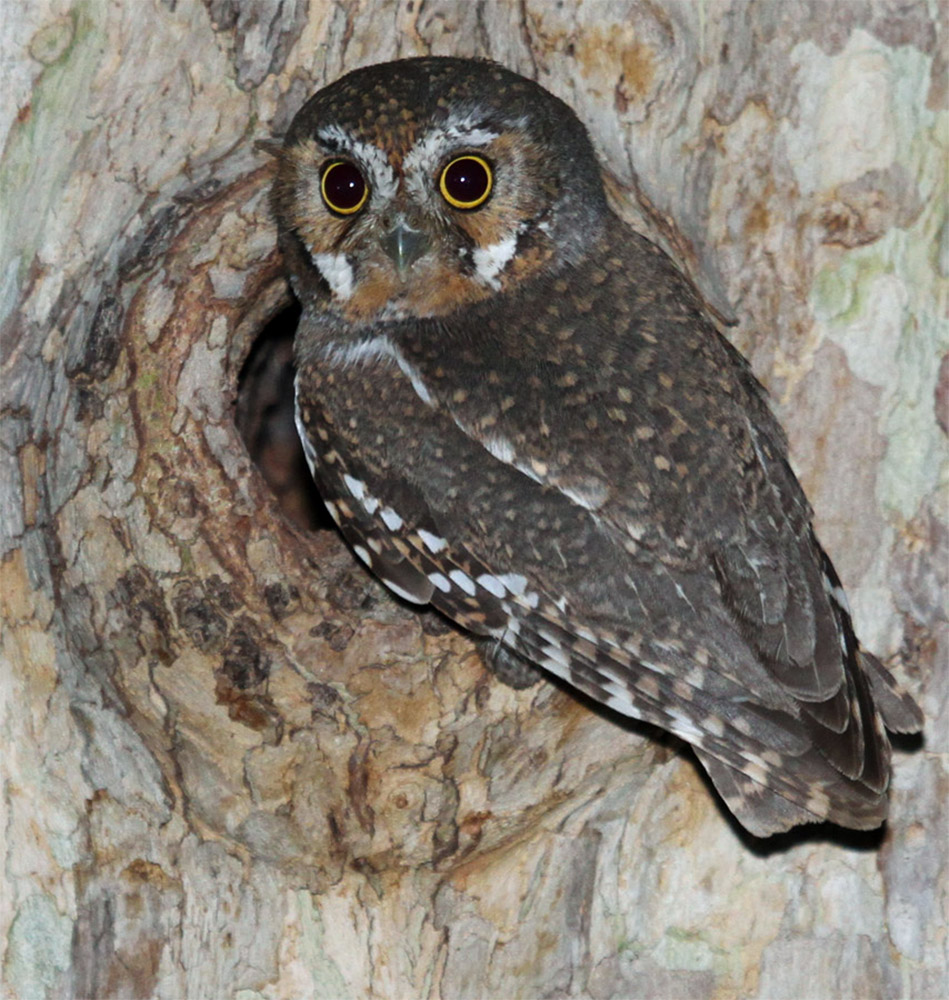
The Elf Owl (Micrathene whitneyi) is a small bird in the owl family Strigidae[5]. It is not listed under the US Endangered Species Act and NatureServe records it as native in Arizona, California, New Mexico and Texas[1][3].
Conservation status
The Elf Owl is not listed as endangered or threatened under the US Endangered Species Act[1]. NatureServe ranks it G4, Apparently Secure, worldwide[2]. In the United States the breeding rank is N5B, Secure (breeding)[6]. The IUCN Red List category recorded by NatureServe is Least concern[7]. It is also on the federal list of birds protected under the Migratory Bird Treaty Act[8].
Where Elf Owl lives
NatureServe lists the Elf Owl as native in Arizona, California, New Mexico and Texas[3]. It is ranked as possibly gone from Nevada[10]. NatureServe also gives each state its own conservation rank[11]. Online observation records come most often from Arizona, Texas, New Mexico, California and Utah, but those counts follow where people look, not how many owls there are[12].
- Native
- Introduced
- Extirpated or possibly extirpated
Show state ranks (5 states)
| State | Rank | Meaning |
|---|---|---|
| Arizona | S5 | Secure |
| California | S1 | Critically Imperiled |
| Nevada | SH | Possibly Extirpated |
| New Mexico | S3B,S3N | Vulnerable (breeding), Vulnerable (nonbreeding) |
| Texas | S4B | Apparently Secure (breeding) |
Habitat
NatureServe records three habitat types for the Elf Owl: hardwood woodland, desert and riparian areas, which are the green strips along streams[13]. In California it nests in riparian forest[14]. In southern Arizona and New Mexico it also nests in desert-wash woodland and evergreen woodland[14]. In Texas it uses desert, canyon forest and evergreen woodland[14].
- Woodland - hardwood
- Desert
- Riparian
Size, diet and lifespan
The Elf Owl is about 15 cm (6 in) long and typically weighs about 41 g[15][16]. It eats mostly insects and other invertebrates, and moths, beetles and crickets are the main foods[17][18]. It waits on a low perch and grabs prey in the air or on the ground[17]. Now and then it takes small lizards, small snakes or young kangaroo rats[17]. The most common clutch is three eggs[19]. The longest recorded lifespan is 14 years in captivity, and the oldest known wild bird was at least 5 years 11 months old[20][4].
| Trait | Value |
|---|---|
| Typical length[15] | 15 cm (6 in) |
| Typical adult weight[16] | 41 g (1.4 oz) |
| Longest recorded lifespan (AnAge)[20] | 14 years (captivity) |
| Oldest known wild bird (banding)[4] | 5 years 11 months |
| Litter or clutch size[21] | 2 |
| Gestation or incubation[22] | 24 days |
| Female maturity[23] | 365 days (about 1.0 years) |
| Food habits[24] | Invertivore |
| Migration[25] | non-migrant, local migrant, long-distance migrant |
- 100% invertebrates
When to look for it
The Elf Owl is active at night and around dusk and dawn[26]. Birds that breed along the US and Mexico border are migratory and spend winter in western Mexico[27]. They usually return in March and leave between late September and early October[27]. Eggs are laid from early May through early June, mostly in late May[19]. Online records peak in April, May and June[28].
Show records by month
| Month | Records |
|---|---|
| January | 3 |
| February | 14 |
| March | 2,423 |
| April | 8,302 |
| May | 7,737 |
| June | 2,942 |
| July | 2,073 |
| August | 1,023 |
| September | 279 |
| October | 53 |
| November | 9 |
| December | 10 |
Where to see it
National Park Service species lists record Elf Owl as present in 15 park units[29]. Present means the park has a confirmed record, not that sightings are common.
- Big Bend National Park
- Carlsbad Caverns National Park
- Chiricahua National Park
- Guadalupe Mountains National Park
- Saguaro National Park
- Amistad National Recreation Area
- Casa Grande Ruins National Monument
- Coronado National Memorial
- Fort Bowie National Historic Site
- Gila Cliff Dwellings National Monument
- Montezuma Castle National Monument
- Organ Pipe Cactus National Monument
- Tonto National Monument
- Tumacácori National Historical Park
- Tuzigoot National Monument
States with the most GBIF observation records: Arizona, Texas, New Mexico, California, Utah[12]. These counts follow where people look and report, not population size.
Questions people ask
Facts and sources
- Elf Owl is not listed as endangered or threatened under the US Endangered Species Act in USFWS ECOS data (checked 2026-10-30). USFWS ECOS
- NatureServe global conservation status rank for Elf Owl: G4 (Apparently Secure). NatureServe Explorer
- NatureServe lists Elf Owl as native in 4 US states and territories: Arizona, California, New Mexico, Texas. NatureServe Explorer
- Oldest known wild Elf Owl from US and Canadian bird banding records: at least 5 years 11 months old (USGS Bird Banding Laboratory). USGS Bird Banding Lab
- Elf Owl (Micrathene whitneyi) is a bird in the family Strigidae, order Strigiformes. NatureServe Explorer
- NatureServe national rank in the United States: N5B (Secure (breeding)). NatureServe Explorer
- IUCN Red List category as recorded by NatureServe: Least concern. NatureServe Explorer
- Elf Owl is on the federal list of migratory birds protected under the Migratory Bird Treaty Act (50 CFR 10.13). eCFR, 50 CFR 10.13
- CITES listing recorded by NatureServe: Appendix II (controls on international trade). NatureServe Explorer
- NatureServe ranks Elf Owl as extirpated or possibly extirpated (SX or SH) in: Nevada. NatureServe Explorer
- NatureServe state ranks for Elf Owl (map and table on this page). NatureServe Explorer
- US states with the most GBIF observation records of Elf Owl: Arizona, Texas, New Mexico, California, Utah. Record counts follow observer effort, not population size. GBIF
- Habitat types NatureServe records for Elf Owl: Woodland - hardwood, Desert, Riparian. NatureServe Explorer
- NatureServe notes on habitat for Elf Owl. NatureServe Explorer
- Typical length recorded by NatureServe: 15 cm (6 in). NatureServe Explorer
- Typical adult weight recorded by NatureServe: 41 g (1.4 oz). NatureServe Explorer
- NatureServe notes on food for Elf Owl. NatureServe Explorer
- Estimated diet composition in EltonTraits 1.0: 100% invertebrates. EltonTraits 1.0
- NatureServe notes on reproduction for Elf Owl. NatureServe Explorer
- Maximum recorded lifespan in AnAge: 14 years in captivity. This is a record, not a typical lifespan. AnAge
- Typical litter or clutch size in AnAge: 2. AnAge
- Gestation or incubation period in AnAge: 24 days. AnAge
- Age at female sexual maturity in AnAge: 365 days (about 1.0 years). AnAge
- Adult food habits recorded by NatureServe: Invertivore. NatureServe Explorer
- NatureServe migration category for Elf Owl: non-migrant, local migrant, long-distance migrant (populations can differ). NatureServe Explorer
- Adult activity patterns recorded by NatureServe: Nocturnal, Crepuscular. NatureServe Explorer
- NatureServe notes on migration for Elf Owl. NatureServe Explorer
- GBIF observation records of Elf Owl in the US by month (chart on this page). GBIF
- NPSpecies park lists recording Elf Owl as present (list on this page). NPS NPSpecies
NatureServe. 2026. NatureServe Explorer [web application]. NatureServe, Arlington, Virginia. Available https://explorer.natureserve.org. (Accessed: October 30, 2026). Licensed under CC BY 4.0; SpeciesFacts selected and summarized it.
Photo: BBODO, CC BY 3.0, via Wikimedia Commons.