All species › Fish › Goldfish
Goldfish
Carassius auratus
Fish · family Cyprinidae · order Cypriniformes
- G1
Critically imperiled - G2
Imperiled - G3
Vulnerable - G4
Apparently secure - G5
Secure
NatureServe global rank G5: secure[2].

- Endangered Species Act
- Not listed[1]
- NatureServe global rank
- G5 Secure[2]
- Longest recorded life
- 41 years[3]
The goldfish is a fish in the family Cyprinidae, and it is not native to the United States[4][5]. It is not listed under the Endangered Species Act, and NatureServe ranks it G5 (Secure) worldwide[2][1].
Conservation status
NatureServe gives the goldfish a global rank of G5, which means Secure[2]. The IUCN Red List category recorded by NatureServe is Least concern[6]. The US Fish and Wildlife Service data show it is not listed as endangered or threatened under the Endangered Species Act[1]. In the states where NatureServe tracks it, the state rank is SNA[7], and NatureServe lists it as introduced (not native) in those places[8].
Where Goldfish lives
USGS lists the goldfish as a nonindigenous aquatic species in parts of the United States[5]. NatureServe records it as introduced, not native, in 42 places, including Texas, Florida, New York, Oregon, Washington and Utah[8][7]. The District of Columbia is also on that list[8]. Observers on GBIF report it most in Illinois, Ohio, New York, Maryland and Texas, but those counts follow where people look, not how many fish there are[9].
- Native
- Introduced
- Extirpated or possibly extirpated
Show state ranks (42 states)
| State | Rank | Meaning |
|---|---|---|
| Alabama | SNA | Not Applicable |
| Arizona | SNA | Not Applicable |
| Arkansas | SNA | Not Applicable |
| Colorado | SNA | Not Applicable |
| Connecticut | SNA | Not Applicable |
| Delaware | SNA | Not Applicable |
| District of Columbia | SNA | Not Applicable |
| Florida | SNA | Not Applicable |
| Georgia | SNA | Not Applicable |
| Idaho | SNA | Not Applicable |
| Illinois | SNA | Not Applicable |
| Indiana | SNA | Not Applicable |
| Iowa | SNA | Not Applicable |
| Kansas | SNA | Not Applicable |
| Kentucky | SNA | Not Applicable |
| Louisiana | SNA | Not Applicable |
| Maine | SNA | Not Applicable |
| Maryland | SNA | Not Applicable |
| Massachusetts | SNA | Not Applicable |
| Michigan | SNA | Not Applicable |
| Mississippi | SNA | Not Applicable |
| Missouri | SNA | Not Applicable |
| Nebraska | SNA | Not Applicable |
| Nevada | SNA | Not Applicable |
| New Hampshire | SNA | Not Applicable |
| New Jersey | SNA | Not Applicable |
| New Mexico | SNA | Not Applicable |
| New York | SNA | Not Applicable |
| North Carolina | SNA | Not Applicable |
| Oregon | SNA | Not Applicable |
| Pennsylvania | SNA | Not Applicable |
| Rhode Island | SNA | Not Applicable |
| South Dakota | SNA | Not Applicable |
| Tennessee | SNA | Not Applicable |
| Texas | SNA | Not Applicable |
| Utah | SNA | Not Applicable |
| Vermont | SNA | Not Applicable |
| Virginia | SNA | Not Applicable |
| Washington | SNA | Not Applicable |
| West Virginia | SNA | Not Applicable |
| Wisconsin | SNA | Not Applicable |
| Wyoming | SNA | Not Applicable |
Habitat
NatureServe records goldfish in big and medium rivers, creeks, pools and shallow water[10]. They are usually found in still water with plenty of plants, such as lakes, reservoirs, ponds and quiet streams[11]. They live in both clear and cloudy water[11]. They spawn in shallow water, and the eggs are scattered and stick to objects[11].
- Big river
- Medium river
- Creek
- Low gradient
- Pool
- Shallow water
Size, diet and lifespan
Goldfish eat aquatic insects, molluscs, crustaceans and worms, and they also eat plants[12]. NatureServe lists adults as invertivores (animal eaters that have no backbone) and herbivores (plant eaters)[13]. The typical length recorded is 30 cm (12 in)[14]. The longest recorded lifespan is 41 years in the wild, and this is a record, not a typical lifespan[3]. Females lay several lots of eggs, with 8 to 10 days between lots[15]. Hatching takes from 2 to 14 days, and the time depends on temperature[15].
When to look for it
Goldfish spawn in spring and summer[15]. NatureServe calls them non-migrant, though populations can differ[16]. GBIF records in the United States are highest in July, August and September[17]. These records show when people look and report, not how many fish there are[17].
Show records by month
| Month | Records |
|---|---|
| January | 102 |
| February | 102 |
| March | 325 |
| April | 719 |
| May | 851 |
| June | 893 |
| July | 1,063 |
| August | 1,120 |
| September | 955 |
| October | 816 |
| November | 231 |
| December | 598 |
Where to see it
National Park Service species lists record Goldfish as present in 18 park units[18]. Present means the park has a confirmed record, not that sightings are common.
- Cuyahoga Valley National Park
- Death Valley National Park
- Grand Teton National Park
- Great Smoky Mountains National Park
- Indiana Dunes National Park
- Mammoth Cave National Park
- Chattahoochee River National Recreation Area
- Chesapeake & Ohio Canal National Historical Park
- Delaware Water Gap National Recreation Area
- Gateway National Recreation Area
- George Washington Memorial Parkway
- Golden Gate National Recreation Area
- Grand Canyon-Parashant National Monument
- Monocacy National Battlefield
- Ozark National Scenic Riverways
- Redwood National and State Parks
- Santa Monica Mountains National Recreation Area
- Stones River National Battlefield
States with the most GBIF observation records: Illinois, Ohio, New York, Maryland, Texas[9]. These counts follow where people look and report, not population size.
Questions people ask
- Is the goldfish endangered?
- No. It is not listed as endangered or threatened under the US Endangered Species Act[1]. NatureServe ranks it G5 (Secure)[2].
- Is the goldfish native to the United States?
- No. USGS lists it as a nonindigenous aquatic species, and NatureServe records it as introduced in 42 places[5][8][7].
- What do goldfish eat?
- They eat aquatic insects, molluscs, crustaceans, worms and plants[12].
- How big do goldfish get?
- The typical length recorded by NatureServe is 30 cm (12 in)[14].
Facts and sources
- Goldfish is not listed as endangered or threatened under the US Endangered Species Act in USFWS ECOS data (checked 2026-10-30). USFWS ECOS
- NatureServe global conservation status rank for Goldfish: G5 (Secure). NatureServe Explorer
- Maximum recorded lifespan in AnAge: 41 years in the wild. This is a record, not a typical lifespan. AnAge
- Goldfish (Carassius auratus) is a fish in the family Cyprinidae, order Cypriniformes. NatureServe Explorer
- USGS lists Goldfish as a nonindigenous aquatic species in parts of the United States (exotic). USGS NAS
- IUCN Red List category as recorded by NatureServe: Least concern. NatureServe Explorer
- NatureServe state ranks for Goldfish (map and table on this page). NatureServe Explorer
- NatureServe lists Goldfish as introduced (not native) in: Alabama, Arkansas, Arizona, Colorado, Connecticut, the District of Columbia, Delaware, Florida, Georgia, Iowa, Idaho, Illinois, Indiana, Kansas, Kentucky, Louisiana, Massachusetts, Maryland, Maine,... NatureServe Explorer
- US states with the most GBIF observation records of Goldfish: Illinois, Ohio, New York, Maryland, Texas. Record counts follow observer effort, not population size. GBIF
- Habitat types NatureServe records for Goldfish: Big river, Medium river, Creek, Low gradient, Pool, Shallow water. NatureServe Explorer
- NatureServe notes on habitat for Goldfish. NatureServe Explorer
- NatureServe notes on food for Goldfish. NatureServe Explorer
- Adult food habits recorded by NatureServe: Invertivore, Herbivore. NatureServe Explorer
- Typical length recorded by NatureServe: 30 cm (12 in). NatureServe Explorer
- NatureServe notes on reproduction for Goldfish. NatureServe Explorer
- NatureServe migration category for Goldfish: non-migrant (populations can differ). NatureServe Explorer
- GBIF observation records of Goldfish in the US by month (chart on this page). GBIF
- NPSpecies park lists recording Goldfish as present (list on this page). NPS NPSpecies
NatureServe. 2026. NatureServe Explorer [web application]. NatureServe, Arlington, Virginia. Available https://explorer.natureserve.org. (Accessed: October 30, 2026). Licensed under CC BY 4.0; SpeciesFacts selected and summarized it.
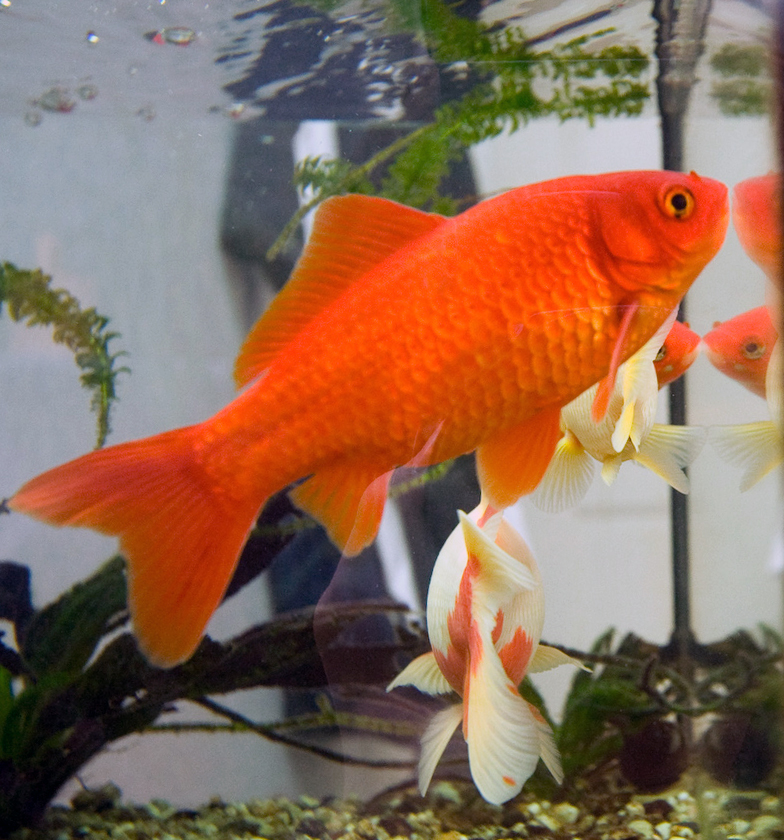
Photo: No machine-readable author provided. Heptagon assumed (based on copyright claims)., Public domain, via Wikimedia Commons.